Many people get confused about the difference between OTG and convection oven. Both look similar, but cook in very different ways. Imagine baking a birthday cake versus reheating leftover parathas. One needs precise baking, the other quick heating. This guide will explain the differences in a simple way, give buying tips, and help you pick the right oven without any technical jargon.
What is Difference Between OTG and Convection Oven
Many people are not sure how OTG and convection ovens differ. Both cook food, but they do it in different ways. Knowing the main differences helps you pick the right oven for your kitchen.
Here are the key differences:
- Heating Technology
- Cooking Speed
- Heat Distribution & Even Cooking
- Cooking Results (Baking, Grilling, Reheating)
- Versatility & Use-Cases
- Capacity Options
- Energy & Electricity Use
- Daily Use Convenience
- Accessories & Tools Compatibility
- Cleaning & Maintenance
- Size, Weight & Space Need
- Price & Budget
- Learning Curve (Ease of Use)
Now, let’s look at each difference one by one.
Heating Technology
The way an oven produces heat is the first big difference between OTG and convection ovens.
OTG:
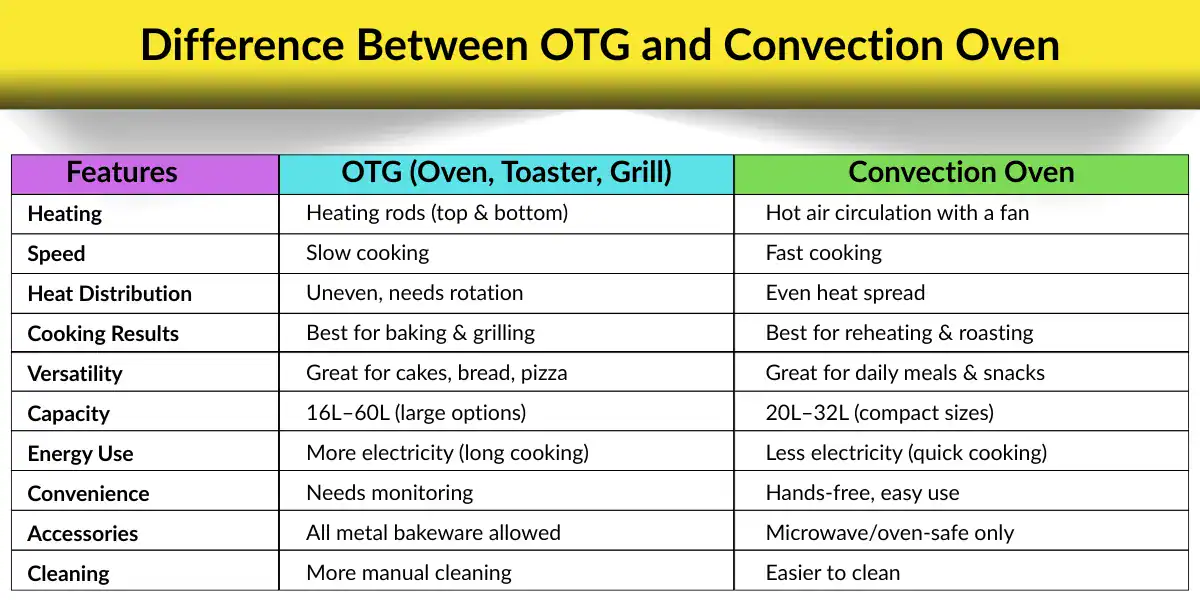
An OTG uses top and bottom heating rods to cook food. Heat comes directly from the coils. This makes OTG perfect for baking cakes, cookies, and grilling. It cooks slowly but gives good browning and texture.
Convection Oven:
A convection oven circulates hot air around the food using a fan. Heat spreads quickly and evenly. This makes cooking faster and consistent. It works well for roasting, reheating, and preparing snacks or everyday meals.
- Tip: If you want a perfectly baked cake with a crisp top, then use an OTG. If you need to roast chicken quickly, then a convection oven works better.
Cooking Speed
How fast an oven cooks food is another key difference between OTG and convection ovens.
OTG:
OTG cooks slowly because it uses only heating rods. Heat builds up gradually, so cakes, cookies, and breads need more time. This slow heating is good for baking because the food rises evenly.
Convection Oven:
A convection oven cooks much faster. The fan pushes hot air everywhere, so heat reaches the food quickly. Your roasted vegetables, paneer, chicken, and reheated food finish in much less time than an OTG.
- Tip: If you want quick daily use, convection is faster. If you want slow and controlled baking, OTG works better.
Heat Distribution & Even Cooking
How evenly an oven spreads heat affects how your food cooks and browns.
OTG:
OTG heats mainly from the top and bottom rods. Because air does not move, some areas get hotter than others. You may need to rotate the tray in the middle of cooking to avoid uneven browning.
Convection Oven:
A convection oven keeps the heat moving all the time. The fan spreads hot air evenly, so every side of the food gets the same heat. This gives you even browning, crisp edges, and consistent cooking without extra effort.
- Tip: If you want hands-free cooking, convection gives better consistency.
Cooking Results (Baking, Grilling, Reheating)
Different ovens give different results for baking, grilling, and reheating.
OTG:
OTG is excellent for baking cakes, cookies, and bread. It grills vegetables and paneer evenly with direct heat. Reheating food takes longer, but baked items get a crisp and golden finish that is hard to match.
Convection Oven:
A convection oven is great for roasting meat and reheating leftovers quickly. It cooks food evenly with hot air circulation. Baking works too, but browning is faster and lighter. Snacks and daily meals are ready in less time.
Versatility & Use-Cases
Different ovens suit different cooking needs. Understanding their use helps you pick the right one.
OTG:
OTG is best for pure baking and grilling. It gives bakery-style results for bread, pizza, cakes, cookies, and tikkas. You can use metal trays, glassware, and standard bakeware without tension.
Convection Oven:
A convection oven suits mixed daily use. You can reheat, cook full meals, grill, roast, and also bake small batches. It works well when one appliance must do many tasks.
- Tip: If your focus is baking quality, choose OTG. If you want one machine for all daily cooking, choose convection.
Capacity Options
The size of an oven affects how much food you can cook at once. Choosing the right capacity depends on your family and cooking needs.
OTG:
OTGs come in a wide range of sizes, usually from 16L to 60L. Large OTGs are perfect for baking multiple cakes, big breads, or grilling for family gatherings. Small OTGs suit occasional use.
Convection Oven:
Convection ovens usually range from 20L to 32L. They are ideal for small to medium portions. You can roast, reheat, or cook snacks efficiently. Their moderate size fits well in compact kitchens.
Energy & Electricity Use
Energy use is important for daily cooking. Knowing how much electricity each oven consumes helps you save bills and choose the most efficient option.
OTG:
OTG uses simple heating rods, so it consumes steady power. Most OTGs run between 1200–2000 watts, and because cooking is slow, total energy use increases in long baking sessions.
Convection Oven:
A convection oven uses higher wattage (usually 1800–2500 watts), but cooks faster. Because of the fan, you finish cooking sooner, so total electricity use often becomes equal or even less for short daily tasks.
Tip:
- Long baking → OTG may consume more.
- Short cooking → convection may consume less.
Daily Use Convenience
Daily usability matters for busy kitchens. An oven that is easy to operate and clean makes cooking faster and more enjoyable.
OTG:
OTG needs more manual control. You choose heating rods, set temperature, and often check the food in between. It feels more like traditional oven-style cooking.
Convection Oven:
A convection oven is easier for quick daily tasks. Just choose a preset like grill, roast, reheat, or bake. The fan and sensors manage the heat automatically. You open the door only when the timer ends.
- Tip: For busy users, a convection oven feels simpler and more automated.
You may also Like: Uses of Convection Oven at Home – Easy Tips You Can Try
Accessories & Tools Compatibility
Knowing which tools and accessories work with your oven makes cooking safer and more versatile.
OTG:
OTGs allow all types of metal bakeware, trays, racks, and skewers. You can use heavy-duty baking dishes or grilling racks without worry. This makes them ideal for traditional baking and grilling recipes.
Convection Oven:
Convection ovens often require microwave-safe or oven-safe accessories. Some models allow metal trays, but it depends on the brand. Using compatible tools ensures even cooking and protects the oven from damage.
Cleaning & Maintenance
Keeping an oven clean is important for hygiene and long-term use. Easy maintenance saves time and effort.
OTG:
OTGs need manual cleaning of trays, racks, and heating rods. Crumbs and grease can stick, so regular wiping is necessary. This keeps the oven safe and working well.
Convection Oven:
Convection ovens are easier to clean because of smooth surfaces and fan-assisted designs. Most trays and racks are dishwasher-friendly or easy to wipe, making daily maintenance simple.
Size, Weight & Space Need
The size and weight of an oven affect where you can place it and how easy it is to handle in your kitchen.
OTG:
OTGs are usually heavier and larger, especially models above 30L. They need a dedicated counter or kitchen space. Moving them around is harder, so plan placement carefully.
Convection Oven:
Convection ovens are compact and lighter. They fit easily on countertops or small kitchen corners. Their smaller size makes them ideal for apartments or kitchens with limited space.
Price & Budget
Price is an important factor when choosing an oven. Knowing your budget helps pick the best option without overspending.
OTG:
OTGs are usually more affordable. You can find models for small budgets as well as larger, advanced ovens. They give value for money, especially for baking and grilling tasks.
Convection Oven:
Convection ovens are generally costlier than OTGs. Mid-range models suit most homes. Their faster cooking and energy efficiency justify the slightly higher price.
Learning Curve (Ease of Use)
How easy an oven is to use affects your cooking experience. Some ovens are beginner-friendly, while others need more practice.
OTG:
OTG needs a little practice. You learn which rod to use, how much time your recipes need, and when to rotate the tray. Once you understand your OTG, the results are excellent.
Convection Oven:
A convection oven is beginner-friendly. Preset modes, auto temperature control, and even heat help you cook well from the first week. You don’t need to adjust settings again and again.
- Tip: If you enjoy learning and fine-tuning, OTG is fun. If you want plug-and-play ease, convection is simpler.
Which Is Better: Convection Oven or OTG?
Choosing the right oven depends on what you cook most. Both have strengths, so the best one varies for different needs.
Performance-Based Comparison:
- Best for Baking: OTG gives even baking and a crisp finish for cakes, cookies, and bread.
- Best for Reheating & Daily Use: Convection oven cooks faster and heats leftovers evenly.
- Best for Grilling: OTG grills food better with strong heating rods.
- Best for Beginners: Convection oven is easier to operate and manage daily meals.
Which One Should You Buy?
Choosing the right oven depends on your cooking habits and kitchen space. Here’s a simple guide to help you pick the one that fits your needs.
Choose an OTG If…
- If you bake often, an OTG is perfect for cakes, bread, and cookies.
- You want strong grilling, OTG gives better direct heat for vegetables and paneer.
- You need large capacity, OTG comes in big sizes for family cooking.
- You want a budget-friendly oven, OTGs usually cost less and offer good value.
Choose a Convection Oven If…
- You reheat food daily, a convection oven warms meals quickly and evenly.
- You want fast cooking, it circulates hot air and reduces cooking time.
- You want easy controls, most convection ovens are simple to operate.
- You have a small kitchen, convection ovens are compact and fit small spaces.
You may also Like these posts:
Types of Oven Explained with Uses & Benefits
Pros and Cons of Convection Oven Explained
Conclusion
Let’s wrap up this topic. We have covered the difference between OTG and convection oven in detail. OTG is great for baking and grilling, while convection oven is perfect for quick cooking and reheating. Pick the oven that suits your kitchen and cooking style. Don’t wait, choose your perfect oven today and start cooking delicious meals!
FAQs about OTG vs Convection Oven
Find clear answers to the most common questions about the difference between OTG and convection oven.
What is the main difference between an OTG and a convection oven?
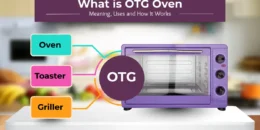
An OTG (Oven, Toaster, Grill) uses heating rods for baking, grilling, and roasting. A convection oven circulates hot air with a fan, cooking food faster and more evenly. OTG suits baking; convection is ideal for reheating and quick cooking.
Which oven is better for baking cakes and bread at home?
OTG ovens are best for cakes, cookies, and bread because heating rods provide direct heat and even browning. Convection ovens can bake, but they cook faster and may brown the top too quickly. Tip: Use OTG for precise baking results.
Can I reheat food in an OTG like a convection oven?
OTGs are not ideal for reheating because they cook slowly and may dry food. Convection ovens circulate hot air evenly, making them faster and better for reheating leftovers or frozen snacks without losing moisture.
How does cooking speed differ between OTG and convection ovens?
OTG ovens cook slower because heat comes from rods. Convection ovens are faster due to fan-assisted hot air circulation. Tip: For quick meals, use convection; for baking or grilling that needs steady heat, use OTG.
Are there any differences in heat distribution between OTG and convection ovens?
OTG heats from the top and bottom rods, so hot spots may appear. Convection ovens spread heat evenly using a fan, ensuring uniform cooking. Example: Roasted vegetables in a convection oven cook evenly on all sides.
Can I use metal or silicone bakeware in a convection oven?
Yes, most convection ovens allow both metal and heat-safe silicone bakeware. Avoid non-oven-safe plastics. Tip: Always check manufacturer guidelines for accessories, as some models may restrict metal for microwaves with convection.
Which oven is easier for beginners to use?
Convection ovens are generally easier for beginners because they cook faster, require less temperature monitoring, and have simple controls. OTGs need more attention, especially for baking and grilling, as heat is less evenly distributed.
How do OTG and convection ovens differ in energy use?
OTGs use more electricity for longer cooking times due to slow rod heating. Convection ovens save energy by cooking faster with circulated hot air. Tip: Use convection for daily reheating or small meals to reduce power consumption.
What factors should I consider when choosing between OTG and convection oven?
- Cooking habits: Baking/grilling (OTG) vs fast daily cooking (Convection).
- Kitchen space: Convection ovens are usually compact.
- Budget: OTGs are often cheaper.
- Accessories: Check compatibility with your trays and bakeware.
Can both OTG and convection ovens be used safely at home?
Yes, both are safe if used properly. Always preheat before baking, avoid leaving food unattended for long, and follow manufacturer’s safety tips. Tip: Keep oven doors closed during cooking to maintain heat and prevent accidents.